10 Tips For New College Students
10 Tips For New College Students
Starting college is a major transition. For many students, it's the first time they're being asked to manage their own time, take greater responsibility for their learning, navigate unfamiliar expectations, and begin developing the habits that will follow them into professional life.
After years of teaching at the college level, I've noticed that student success often has less to do with raw intelligence or talent than people assume. The students who thrive tend to develop a handful of simple habits: they ask questions, manage their time, pay attention, take responsibility, and actively participate in their own growth.
And although these ideas are especially useful for students, they don't stop being relevant at graduation. All of them are really principles for learning, working, and living well.
Here are ten things I wish every new college student knew.
10 Tips For New College Students
1. Ask Questions

If you don't understand something, ask.
That sounds obvious, but many students are surprisingly reluctant to do it. They worry that the question is too basic, that they should already know the answer, or that getting something wrong will make them look foolish.
The opposite is true.
Curiosity is one of the most valuable habits you can develop. Asking thoughtful questions shows that you are engaged and working to understand rather than simply trying to get through the material.
And when you're struggling, ask for help before the problem becomes a crisis. Your professor can't address a problem they don't know exists.
This matters long after college, too. In professional life, people who ask good questions learn faster, make fewer preventable mistakes, and understand systems more deeply. Pretending to understand something you don't is rarely a useful strategy.
You aren't expected to know everything. You are expected to keep learning.
2. Be an Anti-Crastinator

Most people are familiar with procrastination. I would encourage you to become an anti-crastinator instead. When something needs to be done, get it off your plate as early as you reasonably can.
If you receive an assignment on Monday that's due Friday, there are real advantages to beginning it Monday rather than Thursday night.
The course material is still fresh. You have time to discover what you don't yet understand. You can ask questions. You can revise your work. And once the task is finished, your free time actually becomes free time instead of time spent vaguely worrying about something you still need to do.
This doesn't mean completing every task immediately or never taking a break. It means resisting the habit of routinely allowing manageable responsibilities to become emergencies.
That habit pays enormous dividends outside of school. Emails, paperwork, applications, bills, preparation, household tasks, and professional obligations all become easier when you deal with them before urgency takes over.
A surprising amount of stress is not caused by how much we have to do. It's caused by how much unfinished work we are carrying around mentally.
3. Read the Instructions Carefully

Many avoidable mistakes happen because someone simply didn't read carefully.
Students sometimes skim an assignment, assume they understand what is being asked, and then lose points despite knowing the material. The same thing happens on exams: a student answers the question they expected to see instead of the one that was actually asked.
Before beginning an assignment, slow down and make sure you understand the task. What exactly are you being asked to do? What are the required components? What format should you use? Is there a rubric? Are there length requirements? Are there multiple parts to the question?
This principle extends far beyond academics. Contracts, applications, tax forms, workplace instructions, emails, medical information, software prompts, and even recipes reward careful reading.
Attention is a skill.
And in a world constantly competing for that attention, the ability to slow down and accurately understand what is in front of you becomes increasingly valuable.
4. Know the Course Guidelines
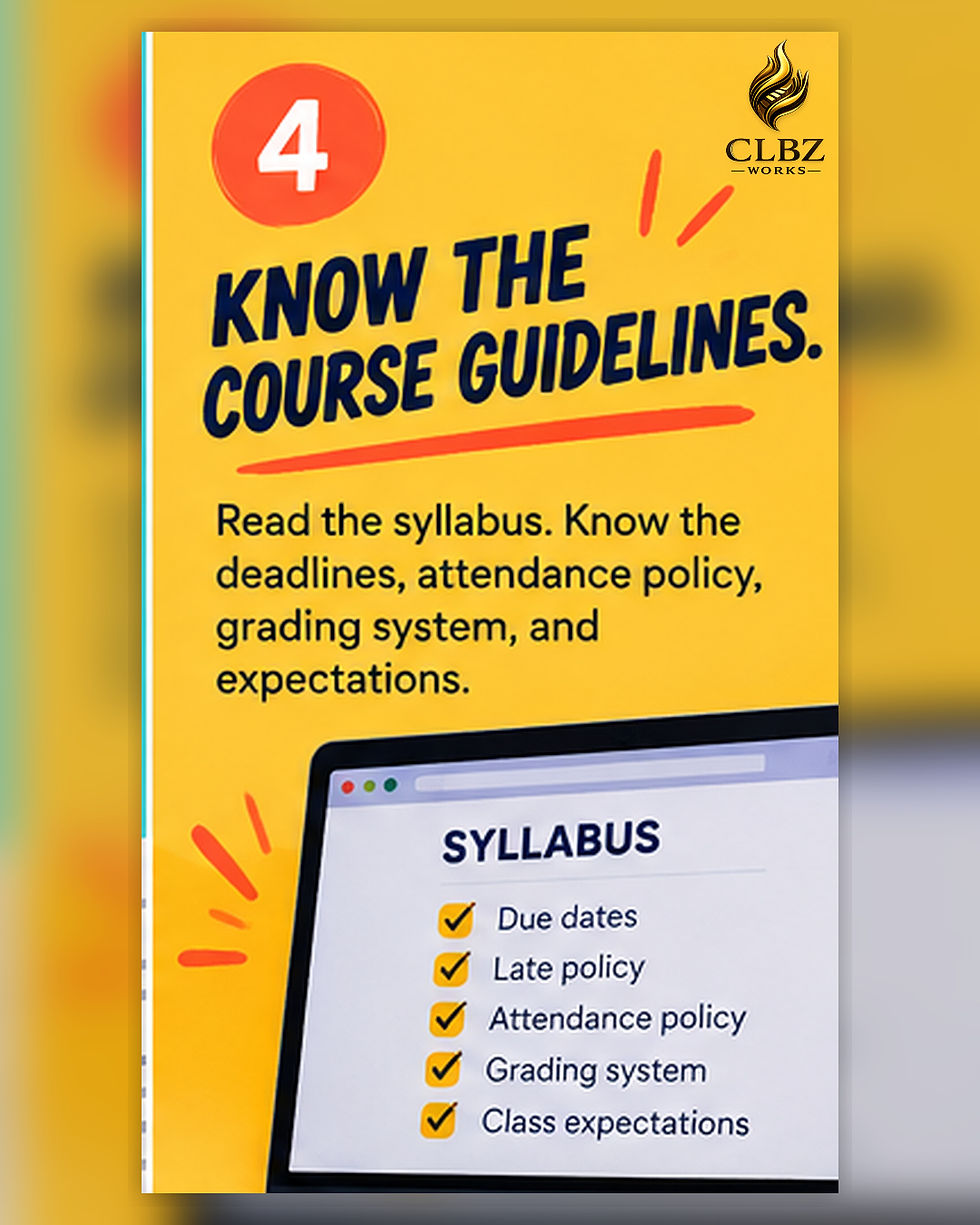
Read the syllabus.
Really.
Your syllabus and course materials generally contain information that can save you a tremendous amount of confusion: due dates, attendance expectations, grading policies, late-work rules, office hours, communication procedures, required materials, and other important details about how the course works.
You don't need to memorize all of it. You do need to know where the information is and take responsibility for consulting it.
One of the broader lessons here is that every environment has a system.
Schools have systems. Workplaces have systems. Organizations have systems. Government agencies have systems. Even families and social groups operate according to explicit and implicit expectations. Learning how a system works makes it much easier to function effectively within it.
Before assuming something is arbitrary or unfair, make sure you actually understand the structure you're operating within.
5. Actually Study and Practice

Going to class is not the same thing as learning. Neither is completing the minimum required assignments.
College courses are generally designed around the assumption that students will spend time outside of class reviewing, practicing, reading, studying, rehearsing, solving problems, or otherwise working with the material.
That outside work matters because learning requires repetition and retrieval. Skills improve through practice. Understanding deepens when you return to material instead of encountering it once and moving on. This is especially obvious in fields like music, language, athletics, and mathematics, but the principle applies almost everywhere.
If you want to become good at something, repeated exposure is not enough. You have to engage deliberately.
That remains true throughout adult life. Expertise is never the result of one class, one workshop, one book, or one training session. Competence comes from returning to a skill repeatedly and continuing to refine it.
Graduation doesn't end the need to practice.
6. Be Professional

Professionalism begins long before you get your first full-time job.
It means showing up when you say you will. Being prepared. Communicating clearly. Treating people respectfully. Taking responsibility when you make a mistake. Following through on commitments. Understanding that your behavior affects other people.
College is a relatively forgiving environment in which to begin developing those habits. That doesn't mean becoming stiff, overly formal, or inauthentic. Professionalism is not a personality type.
It's reliability.
And reliability matters because people remember what it's like to work with you.
Long after someone forgets the grade you received in a particular class, they remember whether you were prepared, generous, dependable, thoughtful, or difficult to collaborate with.
Your reputation is built gradually through ordinary interactions. Start building the reputation you want now.
7. Take Care of Your Body and Mind

Your brain is part of your body.
It's absurdly obvious, of course, but many students behave as though academic performance exists independently of sleep, nutrition, exercise, stress, substance use, or mental health.
It does not.
If you are chronically exhausted, overwhelmed, malnourished, sedentary, or constantly operating under severe stress, learning becomes harder.
Taking care of yourself doesn't require optimizing every aspect of your life or becoming a model of perfect health. It means recognizing that basic physical and psychological needs aren't distractions from your work. They support your ability to do the work.
This lesson becomes even more important after college, when there may no longer be semesters, school breaks, or built-in changes of pace. Adult life can expand indefinitely to fill every available hour unless you establish limits.
Rest isn't something you earn only after everything is finished. Health is part of the infrastructure that makes the rest of your life possible.
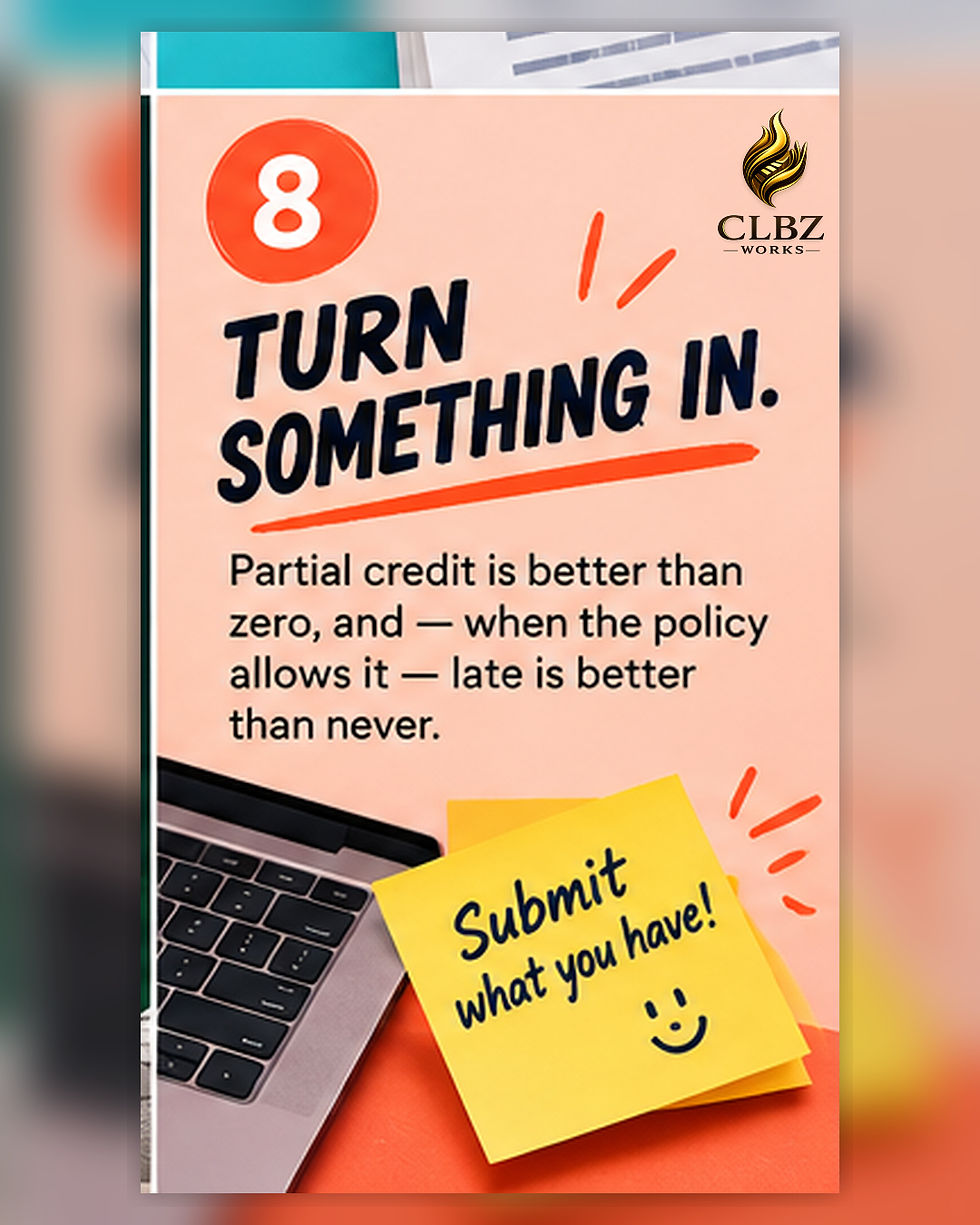
8. Turn Something In
Perfectionism can become self-destructive. A student misses a deadline, feels embarrassed, decides the assignment is no longer worth submitting, and turns a manageable setback into a guaranteed zero. Or they don't finish everything and therefore submit nothing.
Whenever course policy permits it, remember: partial credit is better than no credit, and late is often better than never.
Don't confuse imperfect with worthless.
If you completed 70 percent of an assignment, submit the 70 percent. If you made a mistake, correct what you can. If you fall behind, begin from where you are rather than wasting additional time wishing you had started earlier.
This principle translates into life beyond school. Apply for the job even if your résumé isn't perfect. Send the draft. Make the phone call. Begin the project. Go to the first workout. Practice badly before you practice well.
There are situations where precision genuinely matters, of course. But in many parts of life, an imperfect attempt creates possibilities that doing nothing cannot.
9. Take Responsibility for Your Own Education

A good professor matters enormously. So does a good curriculum, a well-designed course, fair expectations, and effective teaching. And professors aren't perfect. Some are significantly better than others. Sometimes students encounter genuine problems in a classroom.
But even within those limitations, you usually have more control over your education than you realize.
You can participate. You can ask questions. You can read beyond the assignment. You can practice. You can seek other explanations. You can visit office hours. You can form a study group. You can use the library. You can find supplementary resources.
Learning becomes much more powerful when you stop thinking of education as something that is done to you.
This may be the most important habit on the entire list because the world after college does not come with a syllabus. No one will design a complete curriculum for everything you need to learn throughout your career and your life.
Eventually, you have to become your own teacher.
10. Build Relationships

Don't be anonymous.
Talk to your professors. Get to know your classmates. Go to office hours occasionally. Participate in your department or program. Attend events. Introduce yourself. The people around you are part of your education.
A professor may eventually write a recommendation, become a mentor, suggest an opportunity, or introduce you to someone in the field. A classmate might become a collaborator, business partner, colleague, employer, employee, or lifelong friend.
And these relationships shouldn't be approached as cynical networking transactions. The point isn't to accumulate useful people. The point is to participate in a community.
Many of the most meaningful opportunities in life emerge from relationships that couldn't have been strategically planned in advance.
Be interested in people. Be generous. Be dependable. Stay in touch. You never really know where a relationship may lead.
Participate in Your Own Education

College can give you access to extraordinary resources: knowledgeable teachers, specialized equipment, libraries, communities, mentors, structured learning, professional networks, and time devoted specifically to growth.
But access is not the same thing as participation. Ultimately, you have to engage.
And that's the larger lesson behind all ten of these ideas.
Ask questions. Do the work. Pay attention. Take care of yourself. Build relationships. Accept responsibility. Stay curious.
Those habits can help you become a better student. But more importantly, they can help you become a more capable, thoughtful, reliable, and self-directed person.
Your education doesn't end when you receive a diploma. If college does its job well—and you do yours equally well—you learn how to continue educating yourself for the rest of your life.
If you enjoyed these 10 Tips For New College Students, share them with someone you think would benefit from them.
Comments